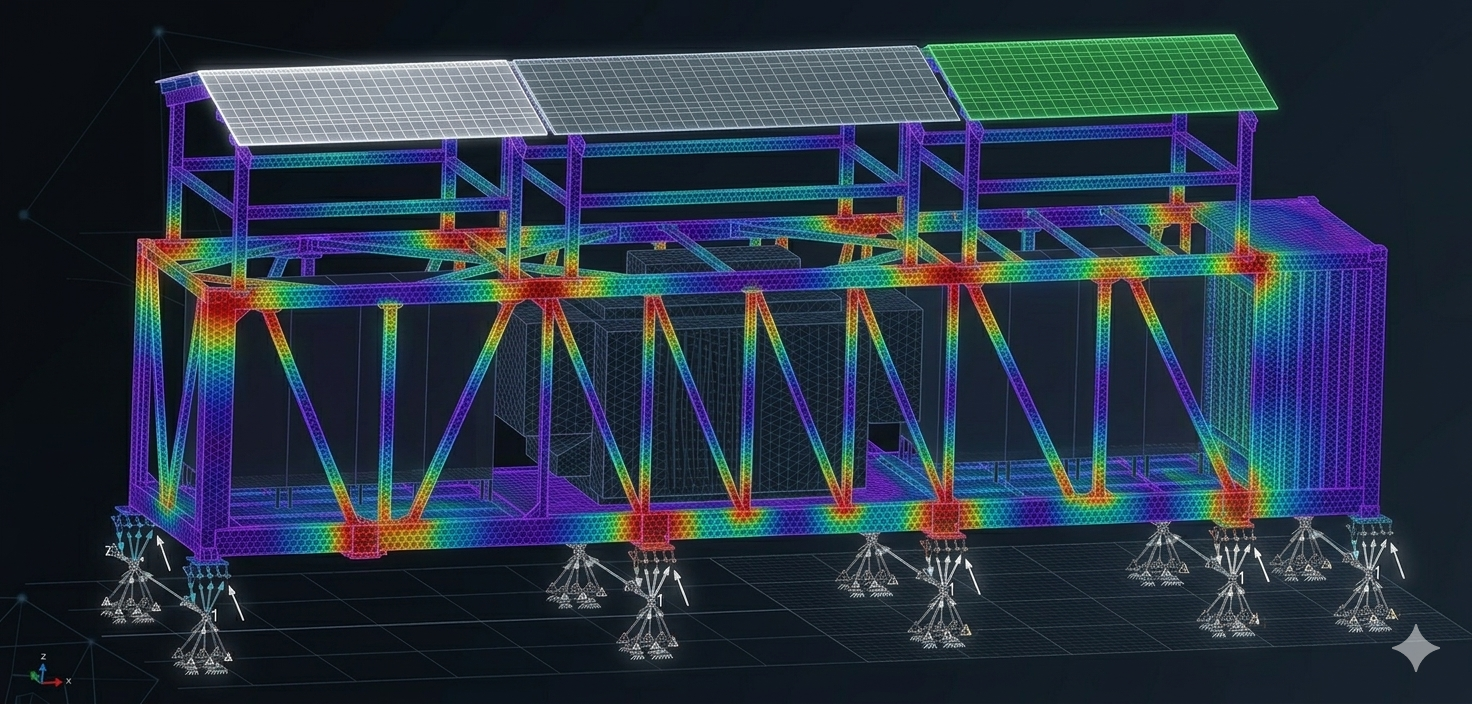
49 load sub-cases. 115 mph wind. Seismic zone. 29.5 tonnes of equipment. Every case passed. Full column reactions delivered for foundation design — in a single delivery cycle.
The client needed structural qualification of their containerised inverter station for deployment on a large-scale 500 MW photovoltaic plant. The container houses a 16-tonne transformer, 5.6-tonne inverter, ring cabinet, auxiliary panels, and a canopy — approximately 29.5 tonnes of dead load distributed across a welded steel frame supported by 10 columns.
The structure had to be proven safe against a demanding combination of environmental and operational loads: 115 mph wind from four directions, significant snow and ice accumulation, moderate-to-high seismicity with directional horizontal and vertical components, and platform live loads — all per ASCE 7-22 requirements.
The client required both Ultimate Limit State (ULS) and Serviceability Limit State (SLS) verification with full per-column reaction data for downstream foundation design and anchor bolt specification.
SIMFORGE built a detailed shell element finite element model of the container's main frame in Ansys Mechanical and systematically evaluated 49+ load sub-cases covering every critical scenario required by ASCE 7-22.
Load derivation followed the code rigorously — wind pressures computed for both the pitched canopy and enclosed frame with four independent wind directions. Seismic forces derived using the component-level Fp method with site-specific spectral parameters.
| Load | Value | Method / Source |
|---|---|---|
| D | 295 kN | Self-weight + all internal equipment |
| L | 4.79 kN/m² | ASCE 7-22 Table 4.3-1 — platforms |
| S | 0.588 kN/m² | Flat-roof snow, Ce = 1.0, Ct = 1.2 |
| Di | 2.825 kN/m² | 32 cm ice layer |
| qh | 1,376.6 N/m² | V = 51.4 m/s, Kz = 0.85, Kzt = 1.0 |
| Fp (horiz.) | 0.536 × Wp | SDS = 0.533 g, Ip = 1.25, CAR = 1.4 |
| Ev (vert.) | 0.107 × Wp | 0.2 × SDS × Wp |
Despite the 115 mph (51.4 m/s) design wind speed, seismic loading governed — confirming that for this product class and site, the seismic combination with horizontal excitation in the transverse direction is the critical design driver.
| Load Combination | Max Disp. | Max σ | Util. | |
|---|---|---|---|---|
| 1.4D | 1.3 mm | 107.4 MPa | 46% | PASS |
| 1.2D + 1.6L + 0.3S | 4.7 mm | 184.4 MPa | 78% | PASS |
| 1.2D + 1.0S + L | 3.2 mm | 147.0 MPa | 63% | PASS |
| 1.2D + W + L + 0.3S | 3.2 mm | 152.7 MPa | 65% | PASS |
| 0.9D + W (worst dir.) | 2.0 mm | 92.2 MPa | 39% | PASS |
| 1.2D + Ev + Eh + L + 0.15S ← governs | 3.6 mm | 225.8 MPa | 96% | PASS |
| 0.9D − Ev + Eh | 3.6 mm | 178.1 MPa | 76% | PASS |
All 10 SLS combination families were evaluated across directional sub-cases. Maximum displacement under serviceability loading was 3.0 mm — negligible relative to the container span. Stresses remained well below yield.
| SLS Combination | Max Disp. | Max σ | |
|---|---|---|---|
| D only | 0.9 mm | 75.2 MPa | PASS |
| D + L | 3.0 mm | 131.0 MPa | PASS |
| D + 0.6W (worst dir.) | 1.3 mm | 87.4 MPa | PASS |
| 1.0D + 0.7Ev + 0.7Eh | 2.6 mm | 162.5 MPa | PASS |
| All remaining SLS combos | ≤ 2.5 mm | ≤ 148 MPa | PASS |
Per-column Fx, Fy, Fz reaction forces were extracted for all 49+ load cases across all 10 columns — providing the civil/foundation engineer with a complete reaction table for anchor bolt sizing and foundation design, directly traceable to code-compliant load combinations.
The governing combination was seismic with transverse horizontal excitation (225.8 MPa, 96% utilization) — not the 115 mph wind case. This finding is critical for foundation and anchor bolt sizing: designing to wind alone would have under-designed the anchorage by roughly 50% in the transverse direction.
The 16-tonne transformer offset to one side means Columns 2 and 7 consistently carried the highest vertical reactions — up to ~183 kN resultant under seismic ULS. Without per-column reaction extraction, a symmetric foundation design would have produced unconservative anchor bolts on the transformer side.
Even under the most aggressive roof suction (−1,462.6 N/m² net) combined with the minimum gravity case (0.9D), all columns remained in net compression. This is a significant cost saving: eliminating hold-down anchors from a 500 MW plant deployment across hundreds of units is a meaningful project-level saving.
The full load matrix — 7 ULS + 10 SLS combination families, each expanded across 4 directional sub-cases — was modeled, solved, post-processed, and delivered in a single engagement. The client received a complete illustrated report with contour plots, reaction tables, and code traceability in one package.
| Load calculation | ASCE 7-22 dead, live, snow, ice, wind & seismic load derivation — all coefficients and factors traceable to code clauses |
| FEA model | Shell element model of container main frame in Ansys Mechanical 2024 R2. Welds modeled, column boundary conditions matched to real support conditions |
| ULS verification | 7 combination families × directional sub-cases = 19 ULS runs. Von Mises stress and utilization vs. S235 yield for each |
| SLS verification | 10 combination families × directional sub-cases = 30+ SLS runs. Total deformation checked against serviceability targets |
| Reaction extraction | Per-column Fx, Fy, Fz for all 49+ load cases — 10 columns × 49 sub-cases = 490 reaction values, formatted for direct use by foundation engineer |
| Deliverable | Full illustrated simulation report: contour plots (stress + deformation) for every sub-case, load calculation annex, reaction force tables, code compliance summary |
Code-driven methodology with every coefficient traceable to clause. Exhaustive directional analysis — not just "worst assumed case". Column-level reaction outputs ready for direct use. Fixed fee, single delivery cycle.
Whether it's a solar inverter, a BESS container, a substation skid, or a process enclosure — if it needs structural qualification to ASCE 7, EN 1993, or another code, we scope it in a 30-minute call and deliver a fixed-fee proposal within 48 hours.
Initial response · 24h · NDA available · Fixed-fee proposal within 48h